Feng Shui Study Desk for Kids and Students: Window or Wall, Desk Direction, and the Wenchang (Study) Corner
Should a kid's study desk face the window or the wall? What parents report after months of homework, the three rules almost everyone agrees on, why the four 'Wenchang' study-corner methods contradict each other, and the lighting and chair details that matter more than compass direction.
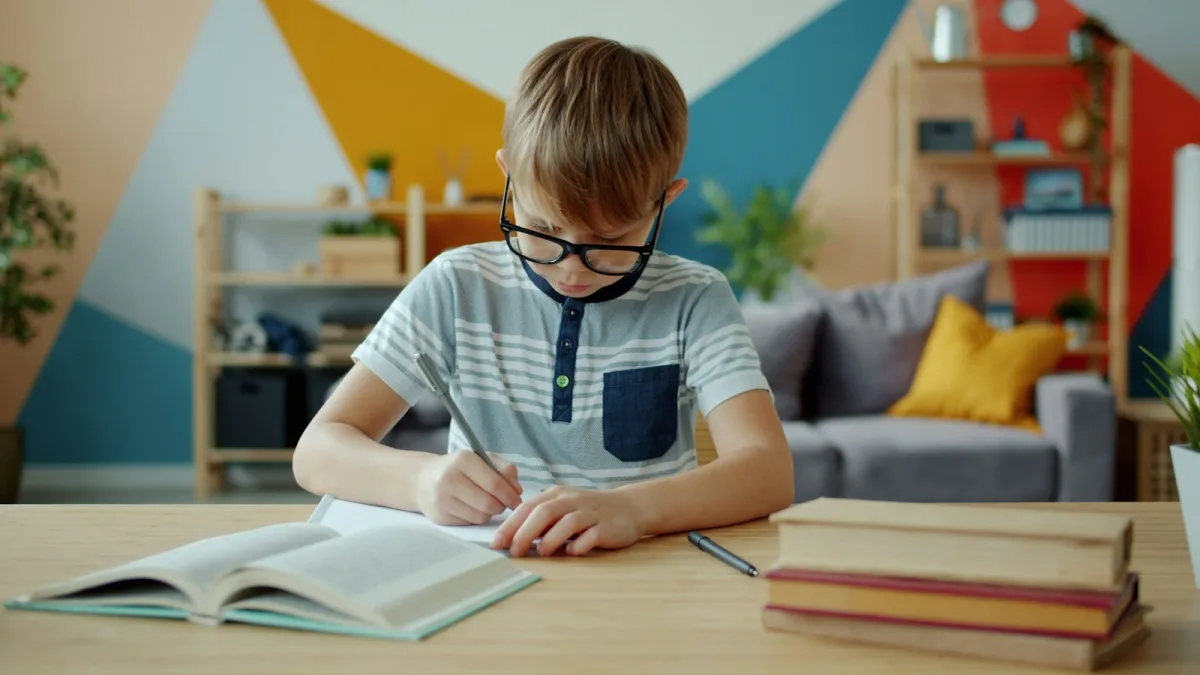
Few home questions start more arguments among parents than this one. A single post asking "Should my kid's desk face the window or the wall?" on Xiaohongshu, the Chinese lifestyle app, drew 886 comments. Parents posted floor plans, photos, test results, and strong opinions.
We went through that thread and about twenty others like it: parents trying layouts with real children for months, feng shui practitioners answering questions under their posts, and families who bought the wrong desk and wrote up the regrets. We checked the Feng Shui rules against English-language practitioner sources and the lighting and eyesight claims against standards and research.
The short version: Feng Shui is maybe a third of what makes a study corner work. The rest is light, a chair that fits, and fewer things to look at.
TL;DR
- Three near-universal rules: don't put the child's back to the door, the chair matters more than the desk, and a big plain table beats a "study desk" with built-in shelves.
- Window or wall depends on the kid. Easily distracted: face the wall, window to the side. Focused: the window is fine.
- Light from the left for right-handed writers (right for left-handers).
- The Wenchang "study corner" has at least four methods that contradict each other. Treat it as an optional layer.
- Myopia isn't prevented by a window desk. Outdoor time is what the research supports.
The Window vs Wall Argument: What Parents Actually Report
The original post came from a parent of a kindergartener whose desk faced a window with a lake view. The window was hard to close with the desk in the way. Should they turn the desk to the wall?
The top comment (624 likes) said yes, with three reasons:
"Facing the wall is better. When I was studying for my own professional exam, my desk faced the window. The view was lovely with the curtains open, so I got distracted easily. I had to close the curtains to focus, and then I'd lost the daylight that was the whole point. Second, for a parent helping with homework, a wall-facing desk leaves room for you to sit beside them. Third, sitting with your back to the door gives you an unconscious sense of insecurity. The child jumps every time someone walks in."
The best answer from the other side (254 likes) came from someone who had been that child:
"I was that kid, and I loved the window. Good light, good mood, and something far away to rest your eyes on. If the light's too strong, use a sheer curtain."
And the most-liked compromise (298 likes) was blunt: "Which way it faces barely matters. Just don't put their back to the door."
The comment everyone remembered got 72 likes: "Desk by the window: watched birds all day, wrote 46 characters. Don't ask how I know."
English-speaking students say much the same. A student on r/SGExams complained that "the natural lighting can be blinding esp at like 4pm and I cannot for the life of me focus on studying." The top reply: "My table face the wall LOL. But like my window is to the right of my desk."
The practical rule
Several parents made the same point: it depends on the child. One wrote, "If your kid tends to daydream, face the wall. If they concentrate easily, the window's fine."
So the most common answer is a hybrid. The desk faces a wall, and the window is beside it. You keep the daylight without making the view the main event.
Rule 1: Don't Put Their Back to the Door
This is the closest thing to unanimous, and it's also classic Feng Shui. The command position says you should be able to see the door without turning around, ideally from a spot diagonal to it, not directly in line with it. Feng Shui calls the solid wall behind you your "mountain" (kao shan).
A Chinese interior designer on Xiaohongshu translated it into three layers. In feng shui terms, "the desk needs a mountain behind it." In design terms, "a work area needs enclosure and a sense of visual safety." In psychology terms, "when your back is exposed, part of your attention keeps scanning behind you."
That last idea echoes prospect-refuge theory, first set out by geographer Jay Appleton in 1975: people prefer spots where they can see out without being exposed. To be fair to the evidence, a 2016 review of empirical studies (Dosen and Ostwald) found the "prospect" half well supported indoors and the "refuge" half more mixed. We found no controlled study on children's homework and door position. What parents report is consistent, though: kids startle, turn around, and lose their place when people walk behind them.
If the room only allows back-to-door, the fixes parents and practitioners suggest, roughly in order:
- A chair with a high back, taller than the shoulders, is a portable "mountain."
- A low bookcase or screen between the chair and the door.
- A small mirror on the desk or wall so the child can see the doorway.
- At minimum, turn the desk sideways so the door is in peripheral vision.
For adult home offices, our desk facing a wall or window guide covers each awkward placement in more detail.
Rule 2: Get the Light Right (It Matters More Than Direction)
The most-liked technical comment in the window thread (338 likes) wasn't about Feng Shui at all: "At that angle the window is on his right, so his writing hand will cast a shadow."
Light from the left for right-handers
For a right-handed child, daylight and the desk lamp should come from the left, so the writing hand doesn't shade the page. This isn't folklore. China's national classroom lighting standard (GB 7793, revised in 2025, in force from November 2026) specifies that in rooms lit from one side, light should enter from the students' left. Left-handed children need the mirror image: window and lamp on the right.
One Xiaohongshu practitioner gave a parent a simple self-check after rearranging: "During the day, there should be no hand shadow on the paper."
How bright?
Classroom standards are a useful benchmark for a home desk:
- China's GB 7793: desk surfaces at least 300 lux on average.
- Europe's EN 12464-1: 300 lux for primary and secondary classrooms, 500 lux for evening classes and reading areas.
A bright overhead light plus a decent desk lamp usually gets there. A cheap built-in lamp on a study desk often doesn't. That was one parent's main complaint about a desk they returned.
Glare is the hidden problem with window desks
If there's a screen on the desk, try the black-screen test a Xiaohongshu home-design account suggested: turn the monitor or tablet off and look at it. If you can see the window reflected, there's too much glare. The fix is to turn the desk so the window is to the side, not in front of or behind the screen.
The balcony study is the extreme case. A parent posted a beautiful sunlit balcony desk, and the most-liked replies were a list of complaints: "Hot in summer, cold in winter." "Afternoon sun, can't see the screen: the full set." "Anyone who's had one knows. Worst spot in the house."
What about eyesight and myopia?
Some parents put desks by windows hoping daylight will slow myopia. One mother wrote up two years at a window desk while her child's prescription improved. That's one child, and many things were changing at once.
The research points somewhere else: time outdoors, not a desk by the window.
- In Taiwan, after schools adopted the "Tian-Tian 120" program (two hours of outdoor time a day), the rate of reduced vision in schoolchildren, which had been rising for a decade, started to fall (Wu et al., Ophthalmology, 2020).
- In a Guangzhou randomized trial, one extra 40-minute outdoor class a day lowered three-year myopia incidence from 39.5% to 30.4% (He et al., JAMA, 2015).
- A 2017 meta-analysis found outdoor time helps prevent onset but doesn't slow progression once a child is already nearsighted.
The American Academy of Ophthalmology's advice for screens is the 20-20-20 rule: every 20 minutes, look at something at least 20 feet away for 20 seconds.
So a window view is a good place to rest the eyes, but it won't do what outdoor time does. A study of Illinois high school students found that a green view during breaks helped attention recover, while daylight alone did not (Li and Sullivan, 2016). The window is for breaks; the wall is for work.
Rule 3: The Chair Matters More Than the Desk
This was the quiet consensus of the most useful posts. A mother documenting four years of her child's study area (1,444 likes) concluded that "the chair matters far more than the desk." Whether a child can sit still, upright, and focused depends on the chair.
The ergonomic basics, from Cornell University's ergonomics guidance for children:
- Feet flat on the floor or a footrest.
- Knees and elbows at about 90 degrees or more open, never tighter.
- The seat edge doesn't press behind the knees.
- Adjustable, because children grow. At an adult-height table, raise the seat and add a footrest.
The caster trap
The best product-design complaint we found (73 likes) described a loop many parents recognized:
"The child has to be a little way from the desk to sit down. Once seated, they can't adjust it, so a parent has to push. But the wheels lock automatically when you sit, so it won't move. So the kid gets off, pushes it into place, and now it's too close to climb onto. I haven't even bought one and I already know about this endless cycle."
Another parent's verdict on a premium chair with a "tracking" backrest: "It never caught up with her back. And when it did, there was no seat left."
What parents look for instead: a chair the child can adjust themselves, a footrest, and either no casters or casters that lock only under weight and roll freely otherwise. Sit your child in it in the store before you buy.
The Desk Itself: Plain and Big Beats "Study Desk"
Two of the most-commented posts were regret stories about study desks with built-in shelves. One parent returned theirs half an hour after assembly:
- First-grade textbooks didn't fit the shelves, so things ended up stacked sideways.
- The shelf height blocked the power outlet.
- A 60 cm deep desk lost 20 cm to the bookcase, leaving 40 cm to write on. "I'm 160 cm tall and it felt cramped when I tried writing at it."
- The built-in lamp was dimmer than the room's ceiling light.
The replies converged on one answer. "Just buy a big plain white table. All those features are useless." (40 likes) "The bigger the desk, the more you realize kids don't need all those functions." (25 likes) "Plain table, manual crank height, a small separate bookshelf, 140 by 70 cm if you have room."
A parent's buying guide (1,034 likes) added two useful points:
- Size: about 100 cm wide for young children, 120 cm as the best all-round size, 140 cm if the room allows.
- Skip electric height adjustment. "Kids don't change posture through the day like adults do. You adjust it about once a year." A manual crank is fine.
There's also a Feng Shui reason for a plain desk: a clear surface. One practitioner's rule was "only the current homework and one pen on the desk." The most-liked reply to that post pushed back: "It's not about the desk. A focused kid can study in a market; a distractible one can stare at an eraser crumb for half an hour." Both are true. A clear desk doesn't create focus, but clutter gives a distractible child more things to look at.
The Wenchang (Study) Corner: Four Methods That Disagree
In Chinese Feng Shui, Wenchang (文昌) is the star associated with study, exams, and writing. Many parents want to know where it is in their home, and comment sections fill up with floor plans and the question "Where's the Wenchang in MY apartment?"
The honest answer is that practitioners use at least four different methods, and they often point to different corners:
| Method | How it works | Where it points |
|---|---|---|
| Fixed Wenchang | A traditional rule associating study with the Southeast | Southeast corner of the room |
| Annual Flying Star | Follows the yearly #4 "scholarly" star | Northeast in 2026 (moves every year) |
| Door-based (Eight Mansions style) | Calculated from the direction the front or room door faces | Varies by home |
| Personal (BaZi) | Derived from the child's birth chart | Varies by person |
For 2026, practitioners including Master Sean Chan and Feng Shui Today place the annual #4 star in the Northeast, linking it to academic success (and to romance, which is less relevant for a fifth-grader). Joey Yap has made the same kind of suggestion for earlier years: simply using the room's #4-star corner to study in that year. But the fixed tradition says Southeast, and the other two methods depend on your floor plan and birthday.
Even the practitioners don't fully agree. One Xiaohongshu post listing four methods admitted that none is definitively "most accurate." Another posted a zodiac-based table, and a reader corrected one of its directions in the comments.
Even the classic remedies are disputed. Some Chinese sources recommend four stalks of lucky bamboo for study, because four is linked to the scholarly star. Many others say never to use four, because the word sounds like "death" in Chinese.
The most sensible practitioners add a disclaimer. One, after explaining his full Wenchang layout, wrote: "If you believe it, treat it as a boost. If you don't, treat it as a story. Placing these things won't pass the exam for you. The core is still the person's own hard work."
Our take: get the position, light, and chair right first. If you'd like to use the Wenchang idea, use it as a way to give the study corner a sense of purpose: a healthy plant, a shelf of books the child actually likes, a clear desk. Don't move the desk somewhere that breaks the first three rules just to hit a compass point.
For how Feng Shui handles compass direction for adults, including Kua numbers, see our desk direction guide.
The Kitchen Table Option
One of the most-shared posts (1,864 likes) wasn't about arranging a desk at all. It was about moving away from it. A parent moved their second-grader's homework from the bedroom to a 1.8-meter dining table in the living room:
"Forty-five minutes to write five characters became done in twenty minutes."
Their explanation was about the room's atmosphere: three people doing three different things at one table, "nobody talking, but a feeling that we're all working together." And the flip side: "You're on the sofa scrolling your phone, he's in his room doing homework, door shut. He knows perfectly well: I'm the only one in this family who's suffering."
The most-liked reply came from a parent whose son was about to graduate from university: "We've always studied together in the living room. When he comes home we still sit around the same table: reading, preparing classes, coding, gaming. It's become our family culture."
English-speaking parents describe the same habit. On r/Parenting, one wrote that "most kids do their homework at the dining table or kitchen counter where parents can make sure they actually do it and help if they need it." Another added a sensible limit: "I always encourage my son to sit at his desk if his task takes longer than 20 or so mins."
This overlaps with what ADHD coaches call body doubling: doing a task with someone else present. It's widely used, though there's little formal research behind it. And it fails if the adult is the distraction. One parent admitted: "I was so productive at the table. Then I looked at my kid and realized she'd been staring into space for an hour."
It works best when the adults are actually working too. That means laptop, book, or bills, not a phone.
The Digital Feng Shui Angle
Every rule above is about removing pulls on a child's attention: the door behind them, the view in front, the clutter on the desk. The strongest pull in most study corners now isn't any of those. It's the phone or tablet within arm's reach.
Some practical rules for the study corner:
- The phone lives somewhere else during homework. Not face-down on the desk. Research on phone proximity suggests even a silent phone in view can cost attention.
- If homework needs a tablet, set it up so only the needed apps work during study time. Many kids are good at getting around Screen Time. Our guide to how kids bypass Screen Time covers the common tricks and the settings that stop them.
- Keep the chargers away from the desk and the bed. Devices charging overnight outside the bedroom is the single change parents most often say helped sleep. (See phone out of the bedroom.)
Action Step
A 15-minute study-corner check
- Sit in your child's chair. Can you see the door without turning around? If not, add a high-backed chair, a screen, or a small mirror.
- Check where the light comes from. For a right-hander, the window and lamp should be on the left. Write a sentence and look for a hand shadow.
- Turn off any screen on the desk. If you can see the window in it, rotate the desk.
- Check the chair: feet flat (or on a footrest), knees not jammed, elbows level with the desk.
- Clear the desk down to today's homework.
- Decide where phones go during homework, and make it a rule for the adults too.
Where to Go Next
- Desk Facing a Wall, Window Behind You, or Back to the Door? — fixes for every awkward desk placement.
- Which Direction Should Your Desk Face? — command position and Kua numbers for adults.
- How Kids Bypass Screen Time — the tricks children use and the settings that stop them.
- What Happens When You Keep Your Phone Out of the Bedroom — the simplest device rule for the whole family.
Frequently Asked Questions
Should a child's study desk face the window or the wall?
It depends on the child. Parents who've tried both mostly report that easily distracted kids do better facing a wall, with the window to the side for daylight, while kids who focus easily can face the window. Nearly everyone agrees on one thing: don't put the child's back to the door.
What is the best direction for a study desk in feng shui?
Feng Shui puts position before direction: a solid wall behind the chair, a view of the door without sitting directly in line with it, and no window directly behind the student. Compass-based rules (the Wenchang or study star location) come second, and the main methods disagree with each other.
Where is the Wenchang (study) position in 2026?
In the annual Flying Star method, the #4 "scholarly" star sits in the Northeast in 2026, according to practitioners such as Master Sean Chan and Feng Shui Today. But a different tradition treats the Southeast as the fixed Wenchang corner, and other methods use the home's door direction or a person's birth chart. They don't agree, so use them as optional layers, not rules.
Which side should the desk lamp be on for a right-handed child?
On the left. Light coming from the left keeps a right-handed writer's hand from casting a shadow on the page. China's classroom lighting standard specifies light from the students' left for this reason. Left-handed children need the opposite: lamp and window on the right.
Is it better for kids to do homework at the kitchen table?
Many parents report that it is, especially for younger children: less wandering, easy help, and the feeling that the whole family is working. The trade-off is noise and interruptions. A common pattern is the shared table for short tasks and a desk for anything longer than about 20 minutes.
Do kids need a special study desk?
Usually not. Parents who bought desks with built-in shelves and lights often regret it: less writing surface, awkward storage, weak lamps. The consensus among parents who've been through it is a plain, large table plus a properly adjustable chair, which matters more than the desk.
Tagged
More in Principles
Desk Facing a Wall, Window Behind You, or Back to the Door? Feng Shui Fixes for Every Awkward Desk Placement
10 min read
Which Direction Should Your Desk Face? Feng Shui Desk Direction Guide for Working From Home (2026)
11 min read
Feng Shui Home Office: Desk Placement, Direction & Layout for Remote Workers (2026)
13 min read
Ready to start from the beginning?
The 30-Day Digital Feng Shui Challenge is a structured, day-by-day program to redesign your digital environment for good.
Start the 30-Day Challenge →