Desk Facing a Wall, Window Behind You, or Back to the Door? Feng Shui Fixes for Every Awkward Desk Placement
Your room only fits the desk one way, and it's the 'wrong' way. Here's how Feng Shui ranks the awkward placements — facing a wall, window behind you, facing a window, back to the door, in line with the door — and the specific fix for each, with the ergonomics that back it up.
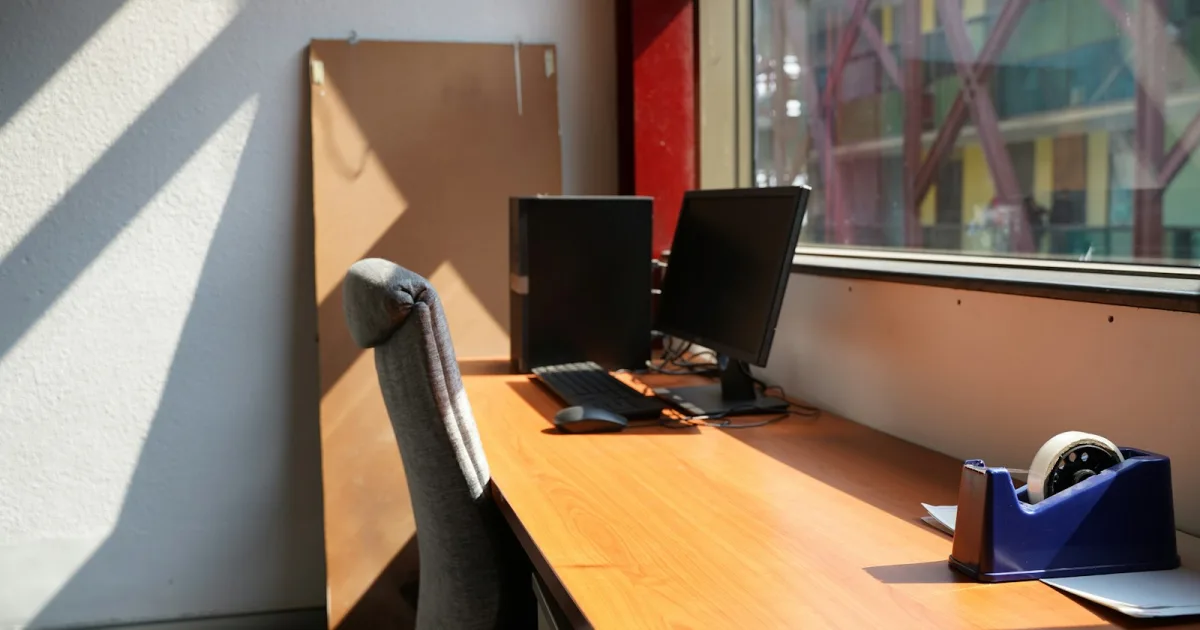
Almost every Feng Shui desk guide describes the same ideal: desk diagonally across from the door, solid wall behind you, window to the side, open view in front.
Then you look at your actual room. The desk fits one place, and it's facing a blank wall. Or the window is right behind your chair. Or the door opens straight onto your back.
A post on r/FengShui sums it up: "I currently have my desk facing the wall, and I end up working in my dining room because it feels uncomfortable." That discomfort is what Feng Shui is describing, and it's usually fixable without new furniture or a bigger room.
This guide is about placement: what's in front of you, behind you, and beside you. If you want the compass-direction question (east vs. southeast, Kua numbers), that's covered in Which Direction Should Your Desk Face?. Placement comes first, so start here.
TL;DR — the severity ranking
- Back to the door — worst. Fix this before anything else.
- Directly in line with the door — nearly as bad.
- Window behind you — no support, plus glare and a backlit video face.
- Facing a window head-on — distracting and hard on your eyes.
- Facing a wall — the mildest. Usually fine with a mirror and the right art.
What's behind you matters more than what's in front of you.
The One Principle Behind All of These
Every fix below comes from one idea: the command position. You should be able to see the door from your desk without sitting directly in line with it, and have something solid behind your back.
The reasoning is old and also very practical. If you can't see who's coming in, part of your attention stays on guard all day. A solid wall behind you means nothing can approach unseen, so you can relax into the work. Interior designers and people who work from home describe the same thing without the Feng Shui vocabulary: some desk spots feel calm and some feel exposed.
So when your room forces a compromise, ask two questions in this order:
- What's behind me? (Wall: good. Window, door, walkway, bed: problem.)
- Can I see the door? (Directly or in a mirror: good. Not at all: problem.)
What's in front of you, whether a wall or a window, comes third.
Placement 1: Desk Facing a Wall
Severity: mild. This is the most common small-room layout, and the least serious problem on the list.
Why Feng Shui flags it: you lose sight of the door, and a blank wall a foot from your face reads as a dead end, with nowhere for your eyes or your thinking to go. People describe it as feeling "boxed in."
Why it's often fine anyway: a wall in front of you is still a solid surface, and if the wall behind you is also solid, your back is covered. Many people working in childhood bedrooms or studio apartments end up here, and commenters on their layouts often say the same thing: the desk is fine, you can see the door, don't put it under the window.
The fixes:
- Add a mirror for the door. A small mirror on the desk or wall, angled so you can see the entrance without turning around. This brings back the half of the command position you lost.
- Give the wall depth. Hang a landscape, a photo with a long view, or anything with perspective. It turns "dead end" into "horizon." Avoid a cluttered pinboard of to-dos at eye level.
- Leave a little gap. Don't jam the desk flush against the wall if you can avoid it. A few inches of breathing room makes the setup feel less cramped.
- Light it from the side. A lamp to one side keeps the wall from feeling like a dark slab.
Placement 2: Window Behind You
Severity: serious. This one feels nice when you set it up, since you get daylight on your desk and a view when you swivel around. It goes wrong in two ways.
The Feng Shui problem: a window behind you is the opposite of a solid back. It's open, changeable space where you can't see what's happening. Traditional practice says it leaves you "unsupported," so you're less likely to feel backed up in your work.
The practical problem: the window shines onto your screen as glare, and on video calls the camera points straight into the daylight, which turns you into a dark silhouette against a bright rectangle. If you take calls, this is the layout most worth changing.
If you can't move the desk:
- Use a high-backed chair. It gives you a "solid back" in a literal sense. This is the standard Feng Shui remedy.
- Add window coverings you can close during work hours. Blinds or curtains help with glare, video backlight, and the open feeling behind you all at once.
- Put something between you and the glass. A tall plant, a low bookshelf, or a credenza under the window gives the space behind you some weight.
- Light your face on calls. A lamp or light in front of you, behind the monitor, balances the backlight.
Placement 3: Desk Facing a Window
Severity: moderate. It seems like the dream setup: natural light and a view. In practice it causes problems for most people working on screens.
The Feng Shui view: a window in front of you pulls your energy and attention outward. One common phrasing is that your qi goes "out the window instead of staying with your work." People report the same thing in plainer terms: they spend the day watching the street.
The ergonomics view: this is where Feng Shui and eye-care advice agree. With a bright window directly behind your monitor, your eyes keep adjusting between the dim screen and the bright daylight, and you get tired faster. Standard workstation guidance is to place screens at a right angle to windows so daylight comes from the side. In a Reddit thread on exactly this choice, the most-agreed-on reply wasn't about Feng Shui at all: "natural light should come from the sides... for eye care."
The fixes:
- Turn the desk 90° so the window is beside you. You keep the light and the view (just turn your head) and lose the glare. This is usually the best layout in the room.
- If you must face it: sheer curtains during work hours, and set the monitor's brightness to the room, not the other way round.
- Never put the window behind the monitor and the door behind you. That combines two problems at once.
Placement 4: Back to the Door
Severity: worst. Every Feng Shui school agrees this one is the problem to fix first.
Why: you can't see who's coming in, so part of your nervous system stays on alert all day. Anyone who has worked with their back to an open office door knows the small jolt when someone appears behind them. One r/FengShui commenter describes it well. Sitting with the door and the walkway behind you means "no solid backing... makes you subconsciously on edge and hard to focus."
The fixes, in order of preference:
- Move or rotate the desk so you can see the door, even at an angle. Almost any orientation with the door visible beats this one.
- Mirror. If the desk truly can't move, a mirror on the desk or monitor edge that shows the doorway is the classic remedy.
- High-backed chair. It gives you something behind your back.
- Close the door while working. A closed door behind you is far less disruptive than an open walkway.
Placement 5: Directly in Line With the Door
Severity: serious. You can see the door, but you're sitting straight in its path, so everything that comes through the doorway heads straight at you. Feng Shui calls this a direct "attack" of incoming energy. In practical terms, every person who walks in is aimed straight at your desk.
The fix: shift the desk diagonally out of the door's line, even by a foot or two. The ideal command position is diagonal to the door for exactly this reason: you see it without being in its path. If you can't shift, put something on the desk between you and the doorway, such as a plant or a monitor arm, to break up the straight line.
Bonus: The Desk in a Bedroom
Bedroom offices combine several of these problems at once, and they come up constantly in Feng Shui forums. In order of priority:
- Keep the door in view (directly or in a mirror).
- Don't sit with your back to the bed. It's the same "unsupported back" problem, and having your bed in view while you work blurs the line between work and rest.
- Mark a separate work zone. A rug or desk mat under the desk, a lamp that only gets switched on for work, or a folding screen. Small things help the room switch between work and sleep.
- Declutter before you rearrange. One commenter told a user who felt "icky" about their desk that the real problem was the tall, looming furniture crowding a small room, not the desk angle. Reducing clutter often fixes the uneasy feeling that people try to solve by moving the desk around.
For the evening side of a dual-purpose room, a grayscale wind-down and a hard shutdown ritual help just as much as layout.
Quick Reference: Problem → Fix
| Placement | Severity | Best fix | If you can't move the desk |
|---|---|---|---|
| Back to the door | Worst | Rotate so the door is visible | Mirror + high-back chair + close the door |
| In line with the door | Serious | Shift diagonally out of the door's path | Plant or object to break the line |
| Window behind you | Serious | Rotate so the window is to your side | High-back chair + blinds + light in front for calls |
| Facing a window | Moderate | Turn 90° so the window is at your side | Sheer curtains + match screen brightness |
| Facing a wall | Mild | Mirror for the door + art with depth | Leave a gap, light from the side |
The Digital Feng Shui Angle
Notice what all five fixes have in common: they're about what can reach you without warning. A door behind you, an open window behind you, a doorway pointed at you. Feng Shui treats unseen approaches as a constant drain on your attention.
Your screen has the same problem. A notification is someone walking in behind you: it arrives unannounced, it breaks your focus, and your nervous system stays slightly braced for the next one. Getting your physical back to a solid wall and leaving your phone pinging all day is like fixing the door and propping open the window. The same command-position logic applies to notifications: decide what's allowed to reach you, and make everything else wait.
Where to Go Next
- Which Direction Should Your Desk Face? — once placement is fixed, the compass layer: Kua numbers and your personal best direction.
- Feng Shui Home Office for Remote Workers — lighting, plants, chair, and the full home-office setup.
- How to Organize Your Computer Desktop — the same principles applied to the screen you face all day.
- How to Manage Phone Notifications — the digital version of keeping your back covered.
Frequently Asked Questions
Is it bad feng shui to have your desk facing a wall?
It's not ideal, because you lose sight of the door and the wall in front of you can feel like a dead end. But it's one of the milder problems, and far less serious than having a window or door behind you. Fix it with a small mirror that shows the door, and hang artwork with depth or a view on the wall in front of you.
Is it bad to have a window behind your desk?
In Feng Shui, yes: a window behind you means no solid support at your back. Practically, it also causes glare on your screen and makes you a dark silhouette on video calls. If you can't move the desk, use a high-backed chair, add curtains or blinds you can close during work hours, and place a tall plant or a shelf between you and the window.
Should my desk face a window?
Not straight on. Feng Shui says your energy drifts out the window, and ergonomics agrees for a different reason: a bright window behind your monitor forces your eyes to constantly adjust between the screen and the daylight. The best compromise is a window to your side, with the desk perpendicular to it.
What's the worst desk position in Feng Shui?
Sitting with your back to the door, followed closely by sitting directly in line with the door. Both leave you unable to see who's coming in, which Feng Shui treats as a constant low-level stress. Fix the door problem before worrying about walls, windows, or compass direction.
What if the only spot for my desk is facing a wall in a small bedroom?
Then face the wall and fix what you can. Make sure you can at least see the door in a mirror, keep the bed out of your line of sight while working, and use a rug, desk mat, or lamp to mark the desk as a separate work zone. In a small room, a solid wall in front is fine. What matters is not having the door or the bed behind you.
Does feng shui desk placement matter more than desk direction?
Yes. Placement, meaning what's behind you and whether you can see the door, is the foundation. Compass direction is a refinement on top. If you can only fix one thing, fix placement — then see which direction your desk should face.
Tagged
More in Principles
Ready to start from the beginning?
The 30-Day Digital Feng Shui Challenge is a structured, day-by-day program to redesign your digital environment for good.
Start the 30-Day Challenge →