Which Direction Should Your Desk Face? Feng Shui Desk Direction Guide for Working From Home (2026)
The honest answer to 'which way should my desk face?' isn't a single compass direction — it's a priority order. Command position first, then your personal Kua number direction. Here's how to find both, and exactly what to do when your small room forces them to conflict.
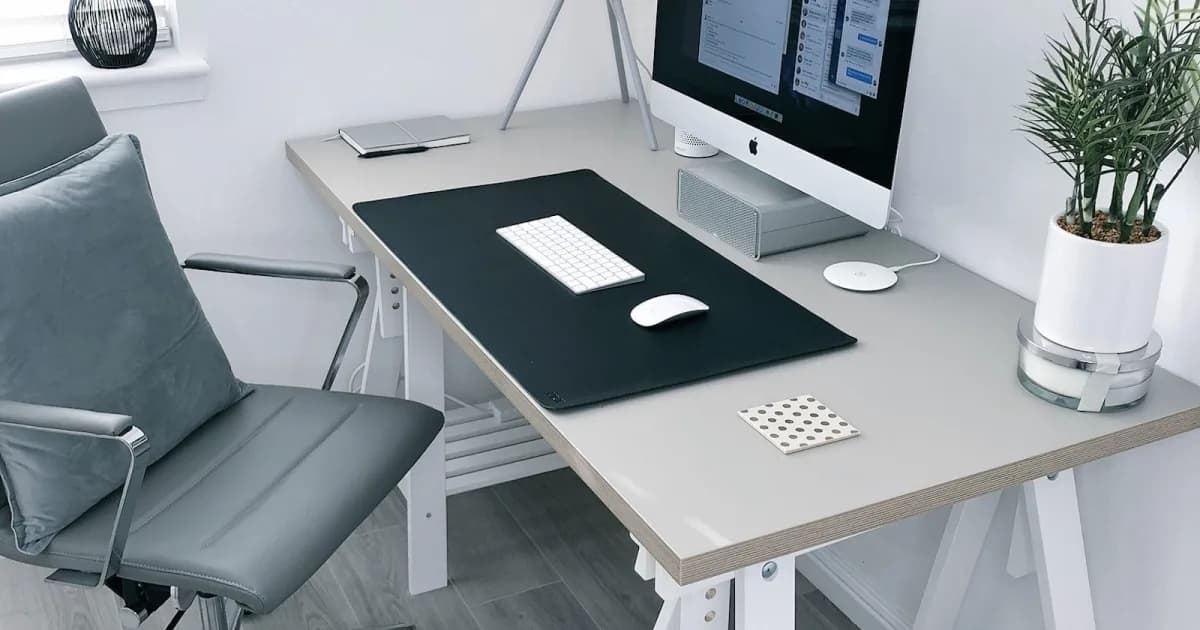
"Which way should my desk face?" is one of the most-searched Feng Shui questions by remote workers — and almost every answer you'll find gives you a single compass direction, usually "east," as if one direction were right for everyone.
It isn't. The honest answer is a priority order, not a direction. And the reason people stay confused is that two different Feng Shui systems are answering two different questions at the same time — and they frequently disagree.
TL;DR
- Placement beats direction. The command position (seeing the door, solid wall behind you) matters more than which compass direction you face. Get this right first.
- Direction is personal. The "best" compass direction depends on your Kua number (from your birth year and gender), not a universal "east."
- When they conflict, command position wins. Face your Kua direction only if it doesn't force your back to the door.
- Small room? You compromise on direction, never on command position.
Two Systems, Two Questions
The confusion comes from treating Feng Shui desk advice as one rule. It's actually two:
- Command Position answers "where should my desk sit in the room?" — this is about placement, sightlines, and what's behind you. It's the foundation of Feng Shui workspace design and it's nearly universal.
- Compass Direction / Kua Number answers "which way should I physically face?" — this is about personal directional energy and it's specific to you.
Most articles blur these together and then tell everyone to "face east." Face east is a fine general default, but if east happens to put your back to the door, following it makes your workspace worse, not better. Placement is the anchor; direction is the fine-tuning.
First Principle: The Command Position
Before you touch a compass, get the placement right. The command position means:
- You can see the door from your desk without being directly in its path.
- You have a solid wall behind your back, not a window or an open doorway.
- You are ideally positioned diagonally across from the entrance (the "kitty-corner" spot).
The reasoning is the same whether you read it as classical Feng Shui or plain psychology: when you can see who's approaching and you have something solid behind you, your nervous system stops spending background energy on vigilance. You settle. You focus. When your back is to the door, part of your attention is permanently reserved for the entrance you can't see — a low, constant tax on your concentration. Remote workers often report this hits harder at home than it ever did at the office: the same back-to-the-door layout they tolerated at work suddenly "feels hard to concentrate" once it's the only desk they use all day.
Watch the window, too. After the door, the most common real-world violation is sitting with a window at your back. It reads two ways at once — as unsupported, open space behind you (no "mountain" to lean on), and as a practical problem: the light behind you backlights your monitor and drags glare across your screen all day. If your only option puts a window behind you, move the desk so the window is to your side, or close a curtain while you work. A window in front or beside you is a gift; a window directly behind you is the layout people most often end up fixing.
If your room makes the true command position impossible, the recognized accommodation is a mirror angled to reflect the door into your sightline. It's less ideal than the real thing, but far better than working blind.
For the full command-position walkthrough, room-by-room layouts, and the rest of the physical setup, see the Feng Shui Home Office guide. This article stays focused on the direction question.
The Eight Directions and What They Govern
In classical Feng Shui, each compass direction carries a different quality of energy. As a general (non-personalized) reference, this is what each direction is traditionally associated with for work:
| Facing Direction | Energy Quality | Best For |
|---|---|---|
| East | Growth, new beginnings | Building something, early-career momentum |
| Southeast | Wealth, abundance | Income-focused and entrepreneurial work |
| South | Recognition, reputation | Leadership, public-facing, creative visibility |
| North | Career, life path | Career advancement, deep independent work |
| Southwest | Stability, relationships | Collaborative work, partnerships |
| West | Creativity, children | Creative output, communication, joy in work |
| Northwest | Leadership, helpful people | Management, networking, mentorship |
| Northeast | Knowledge, self-cultivation | Study, research, skill-building |
If you don't want to calculate anything, east or southeast is the safe general-purpose choice for most growth-oriented work — which is why it's the default advice everywhere. But the personalized version below is where Feng Shui actually gets specific.
Your Personal Best Direction: The Kua Number
Traditional Feng Shui (the Eight Mansions / Ba Zhai system) holds that each person has four favorable and four unfavorable directions, determined by a Kua number (also spelled Gua number) calculated from birth year and gender. For a desk, you want to face your Sheng Qi (生气, "success/wealth") direction — the strongest of your four favorable ones.
How to calculate your Kua number
- Take the last two digits of your birth year and add them together. Keep reducing until you have a single digit. (Example: 1990 → 9 + 0 = 9.)
- Men born before 2000: subtract that digit from 10. (Born 2000 or later: subtract from 9.)
- Women born before 2000: add 5 to that digit, then reduce to a single digit. (Born 2000 or later: add 6.)
- If you land on 5: men use 2, women use 8.
- One catch: the Chinese solar year begins around February 4. If you were born in January or the first few days of February, use the previous year in step 1.
Worked examples:
- Man born 1985: 8 + 5 = 13 → 1 + 3 = 4. Male, pre-2000: 10 − 4 = Kua 6 (West group).
- Woman born 1992: 9 + 2 = 11 → 1 + 1 = 2. Female, pre-2000: 5 + 2 = Kua 7 (West group).
- Man born 2001: 0 + 1 = 1. Male, post-2000: 9 − 1 = Kua 8 (West group).
East Group vs West Group
Every Kua number falls into one of two groups, and your best directions come from your group:
| Group | Kua Numbers | Favorable Directions | Best Work Direction (Sheng Qi) |
|---|---|---|---|
| East Group | 1, 3, 4, 9 | East, Southeast, South, North | Kua 1 → SE · Kua 3 → S · Kua 4 → N · Kua 9 → E |
| West Group | 2, 6, 7, 8 | West, Northwest, Southwest, Northeast | Kua 2 → NE · Kua 6 → W · Kua 7 → NW · Kua 8 → SW |
The one number to remember: your Sheng Qi direction. That's the single best direction to face while working. If you only do one personalization, orient toward your Sheng Qi — and if you can't, any of your other three group directions still beats facing an unfavorable one.
Why the "Best" Direction Seems to Change Every Year
If you've searched this topic more than once, you've probably noticed the advice shifts by year — "best desk direction for 2024," "…for 2026," and so on. That's not marketing filler. It comes from a third, time-based layer of Feng Shui called annual flying stars, where certain compass sectors of any space are considered especially auspicious or afflicted for a given year (practitioners talk about things like a year's wealth star or its "Grand Duke" affliction landing in a particular direction).
This is where a lot of people get stuck. A real and very common version of the confusion: "My Kua number says south is one of my good directions — but I read that south is afflicted this year, and I also shouldn't sit with my back to the door. So is facing south right or wrong?"
Here's the honest way to hold all three layers:
- Command position — permanent, applies every year. The anchor.
- Your Kua direction — permanent to you, from birth year and gender. Your personal fine-tuning.
- Annual flying stars — a yearly overlay that shifts each solar year (around February 4).
For the vast majority of remote workers, layers 1 and 2 deliver almost all the benefit, and they never change. The annual layer is an advanced refinement — worth tracking if you're deep into Feng Shui, but not worth overriding a solid command position or repositioning your whole desk every February. If you do want to follow it, look up the current year's flying-star chart rather than trusting last year's advice, since the sectors genuinely move.
Don't let the annual layer paralyze you. If your personal good direction happens to be a "bad" sector this year, do not turn your back to the door to chase a better heading. A stable command position outweighs an annual affliction every time. At most, add a small remedy (a plant, a bit of metal decor) in the afflicted sector and carry on.
When Command Position and Kua Direction Conflict
This is the real problem almost nobody's advice resolves, and it's the exact situation most remote workers land in: "The command position tells me to sit here facing this way — but that's not my Kua direction. Which do I follow?"
Command position wins. Every time. Here's the decision order:
- Can you satisfy both? Place the desk in the command position and face your Sheng Qi direction. Do this if your room allows it. Rare, but ideal.
- Can't do both? Keep the command position. Then, among your four favorable group directions, pick whichever one comes closest to a valid command-position orientation. You'll almost always find at least one of your four that works.
- Your good direction points straight at a blank wall? This is the single most common version of the conflict — people ask it constantly: "My Sheng Qi direction means facing a wall. Is that okay?" Short answer: a wall in front of you is far less of a problem than a window or door behind you, so keep the command-position orientation. Then soften the wall so it isn't a dead-end — hang art with depth or perspective, add a plant at eye level, or place a mirror to open the view. You get your direction and an unblocked sightline.
- None of your four favorable directions fit the command position at all? Keep the command position anyway and add a directional enhancement instead of turning your desk: a small water feature or a meaningful object placed in your Sheng Qi direction on the desk, so the energy is represented even if you're not facing it.
The logic: a perfectly-oriented desk that puts your back to the door sabotages the very focus the direction was supposed to support. Direction is a multiplier on a good foundation — it can't fix a broken one.
Small Rooms, Bedrooms, and "I Can't See the Door"
Real home offices are bedrooms, corners of living rooms, and closets. Here's how the priorities hold up under constraints:
- Desk in a bedroom: never face the desk so your back is to the bed or the door. If forced to choose, keep the door in view; use a headboard or screen to give the bed its own "back." Keep work and sleep zones visually distinct — a grayscale evening routine and a hard shut-down ritual help the same room switch modes.
- Only wall-facing space: if the sole spot puts you facing a wall, you lose the door sightline — mitigate with a mirror for the door and add visual depth (artwork with perspective, a window to the side, a plant at eye level) so the wall doesn't feel like a dead-end.
- Truly no command position possible: prioritize the mirror-for-door fix over compass direction entirely. A visible door beats a lucky heading.
- Shared or open-plan space: carve out containment — a rug, a plant, a bookshelf as a partial wall — so your desk has a defined "back" even without a physical one.
The rule that survives every constraint: you compromise on direction, never on the command position.
The Digital Feng Shui Layer: Direction for Screens
Here's what the furniture blogs miss — for a remote worker, the thing you actually face all day isn't a compass heading, it's a screen. Directional Feng Shui has a digital dimension:
- Your monitor is the new "facing." Whatever direction your primary monitor sits, that's the energy your attention pours into for eight hours. Align the monitor with the desk's good direction rather than fighting it.
- Windows behind the screen = glare and drained Chi. A window directly behind your monitor backlights it, forces your eyes to fight, and (in command-position terms) puts open, unsettled space behind your work. Put windows to the side.
- Keep your sightline free of notification sources. A second monitor or a propped-up phone buzzing in your peripheral vision is a "poison arrow" of interruption aimed straight at your focus. Silence it — a Focus mode or Do Not Disturb schedule clears the digital sightline the way a clean wall clears the physical one.
- Video-call backdrop is your "facing" to the world. What's behind you on camera is what colleagues face when they look at you. A solid, uncluttered backdrop reads as grounded and in-command; a doorway or messy shelf reads as exposed.
Quick Answers by Scenario
- "Just tell me one direction": Face east or southeast, as long as it doesn't put your back to the door.
- "I want the personalized version": Calculate your Kua number, face your Sheng Qi direction, command position permitting.
- "My room only allows one layout": Take the command position and pick the closest of your four favorable directions. Done.
- "I'm in a bedroom": Door in view, back to a solid wall, work zone visually separate from the bed. Direction is secondary here.
The Digital Feng Shui Angle
Direction, at its core, is about what you point your attention at.
Classical Feng Shui obsesses over facing because your orientation decides what fills your field of view — and your field of view quietly decides your mental state. Face a wall, feel boxed in. Face a door with your back exposed, stay subtly braced. Face your good direction over a solid foundation, and the room stops fighting you.
The modern version is the same question aimed at your screen. You point your body at a good direction, then point your eyes into a browser with forty tabs and a notification every ninety seconds — and undo all of it. Physical direction and digital direction are the same discipline: decide what deserves to be in front of you, and remove what doesn't.
Where to Go Next
- Feng Shui Home Office: Desk Placement, Direction & Layout — the full pillar guide: command position, five elements, lighting, chair, and the complete remote-work setup.
- Do Not Disturb & Focus Mode Guide — clear the digital sightline so your good direction isn't undone by pings.
- Grayscale Mode Guide — help a dual-purpose room switch out of work mode in the evening.
- What is Digital Feng Shui? The Bagua Map Explained — the same directional energy map, applied to your digital spaces.
Frequently Asked Questions
Which direction should my desk face for work?
There's no single answer for everyone. The general default is east or southeast for growth-oriented work, but the personalized best direction is your Sheng Qi direction from your Kua number. Whichever you choose, it only applies if it doesn't force your back to the door — the command position always takes priority over compass direction.
What if my Kua direction means sitting with my back to the door?
Then don't follow it. Keep the command position (door in view, solid wall behind you) and pick whichever of your four favorable group directions comes closest to a valid orientation. A lucky direction with your back exposed does more harm than a neutral direction where you feel secure.
How do I calculate my Kua number?
Add the last two digits of your birth year and reduce to one digit. Men born before 2000 subtract it from 10 (from 9 if born 2000+); women born before 2000 add 5 (add 6 if born 2000+), then reduce. If you get 5, men use 2 and women use 8. If you were born in January or very early February, use the previous year, since the Chinese solar year starts around February 4.
Is east really the best direction for a desk?
East is the safe general recommendation because it's associated with growth and new beginnings, which suits most work. But "best" is personal — for a West Group person (Kua 2, 6, 7, or 8), east is actually one of their unfavorable directions. That's why the Kua number matters more than a one-size-fits-all rule.
Does desk direction matter more than desk placement?
No. Placement — specifically the command position — is the foundation and matters more. Direction is a refinement layered on top. If you can only get one right, get the command position; a well-placed desk facing a neutral direction beats a poorly-placed desk facing a "lucky" one.
What direction should my desk face in a small bedroom office?
Prioritize keeping both the door and (ideally) not the bed at your back, with a solid wall behind you. Compass direction comes last in a constrained bedroom. Use a screen or headboard to separate the work zone from the sleep zone, and keep the two visually distinct so the room can switch modes.
Does the direction my monitor faces matter?
Practically, yes — your monitor is what you actually face all day. Avoid placing a window directly behind it (glare plus unsettled space behind your work); put windows to the side instead, and keep buzzing phones or second screens out of your peripheral vision so your sightline stays free of interruptions.
Does the best desk direction change every year?
Your personal best direction (from your Kua number) and the command position never change. What shifts yearly is a separate, advanced layer called annual flying stars, where certain compass sectors are considered auspicious or afflicted for a given solar year — that's why you see "best direction for 2026" advice that differs from last year's. For most remote workers it's an optional refinement, not a reason to reposition your desk every February. And never turn your back to the door to chase a better annual heading: a stable command position outweighs an annual affliction every time.
Tagged
More in Principles
Ready to start from the beginning?
The 30-Day Digital Feng Shui Challenge is a structured, day-by-day program to redesign your digital environment for good.
Start the 30-Day Challenge →